Retail liability for black ice falls on Black Friday
Benchmark Injury Law ·
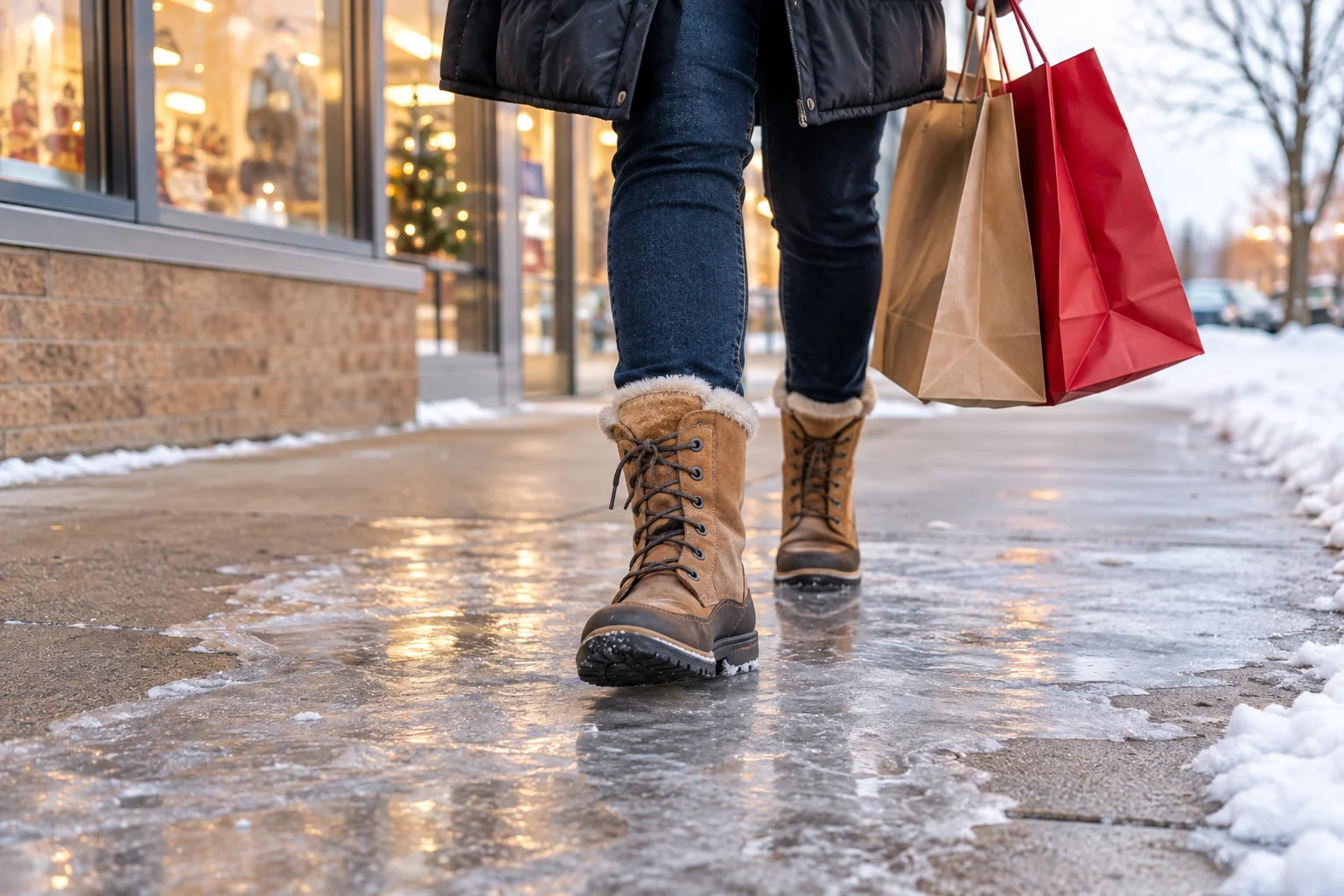
The direct answer on retail liability for black ice
Black Friday brings more foot traffic than almost any other day of the year. That volume raises the stakes for black ice outside your store. Knowing where your responsibility starts and stops can determine whether a fall becomes a lawsuit.
Retail stores are generally liable when a customer slips on black ice in an area the store controls, if the store knew about the hazard or had enough time to discover and address it. That standard is called premises liability, and most states apply it to any business that invites the public onto its property. The key phrase is "reasonable care." Courts look at whether the store took steps a reasonable business owner would take to keep the walkway safe.
The answer is not automatic. A store does not become liable simply because someone fell. The injured person must show that the store was negligent, meaning the ice was present long enough that the store should have known, and the store did nothing about it. That distinction matters a great deal on a day like Black Friday, when conditions can change fast and staff are stretched thin.
What "control" means and why it matters
Liability follows control. If your store owns or leases the sidewalk directly in front of your entrance, that surface is almost certainly your responsibility. If the city owns the public sidewalk and you have no lease obligation to maintain it, responsibility may shift to the municipality.
The boundary is not always obvious. Many retail leases include language that assigns snow and ice removal duties to the tenant, even for shared parking lots. Read your lease before Black Friday, not after a fall. If your lease says you are responsible for the front 20 feet of pavement, that is on you regardless of who owns the land underneath.
Shopping center tenants face a different structure. The property management company typically handles the parking lot and common areas. If a customer falls in the main lot, the landlord or property manager likely bears primary responsibility. If the fall happens on the walkway immediately outside your storefront, your lease terms will determine who is on the hook. Know the boundary and document it.
The notice requirement: how long is too long
Courts do not expect store owners to eliminate ice the moment it forms. They expect a reasonable response once the owner knew or should have known the hazard existed. That window is called constructive notice, and it is at the center of most slip and fall claims.
If freezing rain started at 4 a.m. and a customer fell at 6 a.m., the store had two hours to inspect and treat the walkway. Whether two hours is enough depends on the state, the storm conditions, and what the store's usual maintenance schedule looks like. If the store had a crew working at 5 a.m. and they never checked the front entrance, that gap is hard to defend.
On Black Friday, stores often open between midnight and 5 a.m. Temperature drops overnight are common in November across most of the country. That means your highest-risk window, the early morning hours before dawn, overlaps directly with your highest-traffic window. A written inspection log with timestamps is not just good practice. It is evidence.
Common exceptions that limit or eliminate liability
Several exceptions can reduce or eliminate a store's liability even when ice was present and a customer fell.
Natural accumulation doctrine. Some states, including Illinois and Ohio, have recognized a rule that property owners are not liable for ice that accumulated naturally from weather, without any action by the owner making conditions worse. This doctrine has exceptions of its own, and many states have narrowed or eliminated it. Do not assume it applies in your state without checking.
Comparative fault. Most states allow a jury to assign a percentage of fault to the injured person. If a customer was running, ignored visible warning signs, or wore clearly inappropriate footwear for icy conditions, that can reduce the store's share of liability. In states with contributory negligence rules, significant fault on the customer's part can bar recovery entirely.
Open and obvious hazard. If the ice was clearly visible and any reasonable person would have recognized the danger, the store may argue the hazard was open and obvious. Courts apply this inconsistently, and a heavily trafficked entrance on Black Friday, where customers are distracted and moving fast, complicates the argument.
Landlord responsibility. As noted above, if the property management company was responsible for ice removal under the lease and failed to act, the store may have a third-party claim against the landlord rather than bearing the full loss alone.
What a reasonable response looks like in practice
Reasonable care has a concrete shape. It is not a vague standard you can satisfy by hoping for warm weather.
Check the forecast the night before. If temperatures are expected to drop below freezing overnight, schedule an early inspection before doors open. Apply salt or sand to any icy surface at least 30 to 45 minutes before the first customer arrives. Post wet floor signs or cones near any entrance that is difficult to fully treat. Document every step with timestamps and the name of the employee who performed the inspection or treatment.
If a customer falls, do three things immediately. Get them medical attention if needed. Write an incident report while the details are fresh, noting the time, the exact location, the conditions, and any witnesses. Take photographs of the surface within the hour. That documentation is the difference between a defensible claim and an expensive settlement.
Stores that treat ice removal as a one-time task at opening are exposed for the rest of the day. Temperature changes, foot traffic, and shade patterns can refreeze a treated surface by mid-morning. Assign someone to check high-traffic entrances every two hours throughout the day.
How Black Friday specifically changes the risk calculation
Black Friday is not a typical retail day, and courts know it. Foot traffic on Black Friday can run three to five times higher than a normal Saturday. That volume means more people crossing the same patch of ice in a short window, more distracted customers focused on deals rather than footing, and more pressure on staff who are managing crowds rather than monitoring conditions.
That context cuts against the store in a liability dispute. A judge or jury knows that a store expected an extraordinary number of customers. That expectation raises the standard of care. A store that inspects once at 4 a.m. and assumes the walkway is fine until noon is not meeting a reasonable standard on a day when several hundred people may cross that surface by 7 a.m.
Insurance carriers have flagged Black Friday as a high-claim period for general liability. Some policies include provisions that require documented safety procedures on high-traffic days. Review your policy before the season. If your carrier expects a written inspection protocol and you do not have one, a denied claim on top of a lawsuit is a painful outcome.
The lease and insurance documents you need to review now
Two documents determine your exposure before any ice forms. Your commercial lease and your general liability insurance policy.
In your lease, look for language about maintenance obligations, snow removal duties, and indemnification clauses. An indemnification clause may require you to hold the landlord harmless for any injury on your premises, even one caused by the landlord's failure to maintain common areas. That language shifts risk onto you in ways that feel unfair but are legally binding.
In your insurance policy, confirm that your general liability coverage includes premises liability for slip and fall claims. Check your per-occurrence limit and your aggregate limit. A single Black Friday slip and fall claim with a serious injury, a broken hip or a head injury, can produce a demand that tests both numbers. If your limits feel low relative to your foot traffic, talk to your broker about umbrella coverage before the holiday season.
Keeping records of your ice removal efforts also matters for insurance purposes. A claim that arrives with an inspection log, photographs, and an incident report is far easier for your carrier to defend than one that arrives with nothing.
When to bring in a professional and how to reach us
This article gives you the framework. It does not replace a licensed attorney in your state. Premises liability law varies meaningfully by state. The natural accumulation doctrine, comparative fault percentages, and notice standards all differ. If you receive a demand letter or a lawsuit filing, retain an attorney who handles premises liability before you respond.
For the operational side, businesses that want to protect themselves before an incident should work with a commercial property maintenance vendor who provides written service logs, documented treatment times, and confirmation of product application. That paper trail is evidence. A vendor who cannot provide it is not worth the contract.
Talloo works with local businesses on the visibility and trust infrastructure that keeps customers choosing them over larger competitors. If your business needs to build a stronger local presence so the right customers find you year-round, get in touch for a quote. We will tell you exactly what your situation calls for.
Frequently asked questions
Is a retail store automatically liable if someone falls on black ice outside the entrance?
No. Liability requires proof that the store controlled the area, knew or should have known about the ice, and failed to take reasonable steps to address it. A fall alone does not establish negligence. The injured person must show the store had time to discover the hazard and did not act.
What if the city owns the sidewalk outside my store?
If the municipality owns the sidewalk and your lease does not assign you maintenance responsibility for that surface, liability may fall on the city rather than your business. Check your lease carefully. Many commercial leases assign snow and ice removal duties to the tenant regardless of who holds title to the land.
Does the natural accumulation doctrine protect my store from black ice claims?
It depends on your state. Illinois and Ohio have recognized this doctrine, which limits liability for ice that accumulated naturally from weather. Many states have narrowed it significantly, and courts apply exceptions when the property owner made conditions worse. Confirm whether your state recognizes it before relying on it as a defense.
How long does ice need to be present before a store is considered on notice?
There is no fixed number of hours that applies in every case. Courts look at whether the store had a reasonable opportunity to discover and address the hazard given the weather conditions and the store's normal inspection schedule. On Black Friday, with early opening times and overnight temperature drops, two hours without an inspection is often considered too long.
What records should I keep to defend against a slip and fall claim?
Keep a written inspection log with the name of the employee, the time of inspection, the conditions observed, and any treatment applied. Take photographs of the entrance surface at opening and again mid-morning. If a fall occurs, complete an incident report immediately with the time, location, conditions, and any witnesses. These records are your primary defense.
Does my commercial lease affect my liability for the parking lot?
Yes. Many retail leases assign parking lot and walkway maintenance to either the tenant or the property management company. If your lease places that duty on the landlord and the landlord failed to treat the lot, you may have a third-party claim against the landlord. If the lease assigns it to you, you bear the exposure regardless of who owns the property.
Can a customer's own behavior reduce or eliminate my liability?
Yes. Most states use comparative fault rules that reduce the store's liability by the percentage of fault assigned to the customer. If the customer was running, ignoring posted warnings, or wearing clearly unsafe footwear, those facts are relevant. In a small number of states with contributory negligence rules, significant customer fault can bar recovery entirely.
Does Black Friday specifically raise my standard of care for slip and fall liability?
In practice, yes. Courts and juries consider what a reasonable business owner would do given the expected conditions. A store that opens at 4 a.m. for Black Friday and expects hundreds of customers by 6 a.m. is expected to inspect and treat walkways before those customers arrive. The higher the foreseeable traffic, the more scrutiny a single inspection at opening will receive.
What should I check in my general liability insurance policy before Black Friday?
Confirm that your policy includes premises liability coverage for slip and fall claims. Review your per-occurrence and aggregate limits against your expected foot traffic. Check whether your policy requires documented safety procedures on high-volume days. If your limits feel low or your policy has undocumented requirements, talk to your broker before the holiday season opens.
When does a black ice slip and fall situation require an attorney?
Any time you receive a demand letter, a lawsuit filing, or a subpoena, retain a premises liability attorney in your state before responding. Premises liability law varies by state on notice standards, comparative fault percentages, and doctrines like natural accumulation. A general answer from an article is not a substitute for legal advice tied to your specific jurisdiction and facts.